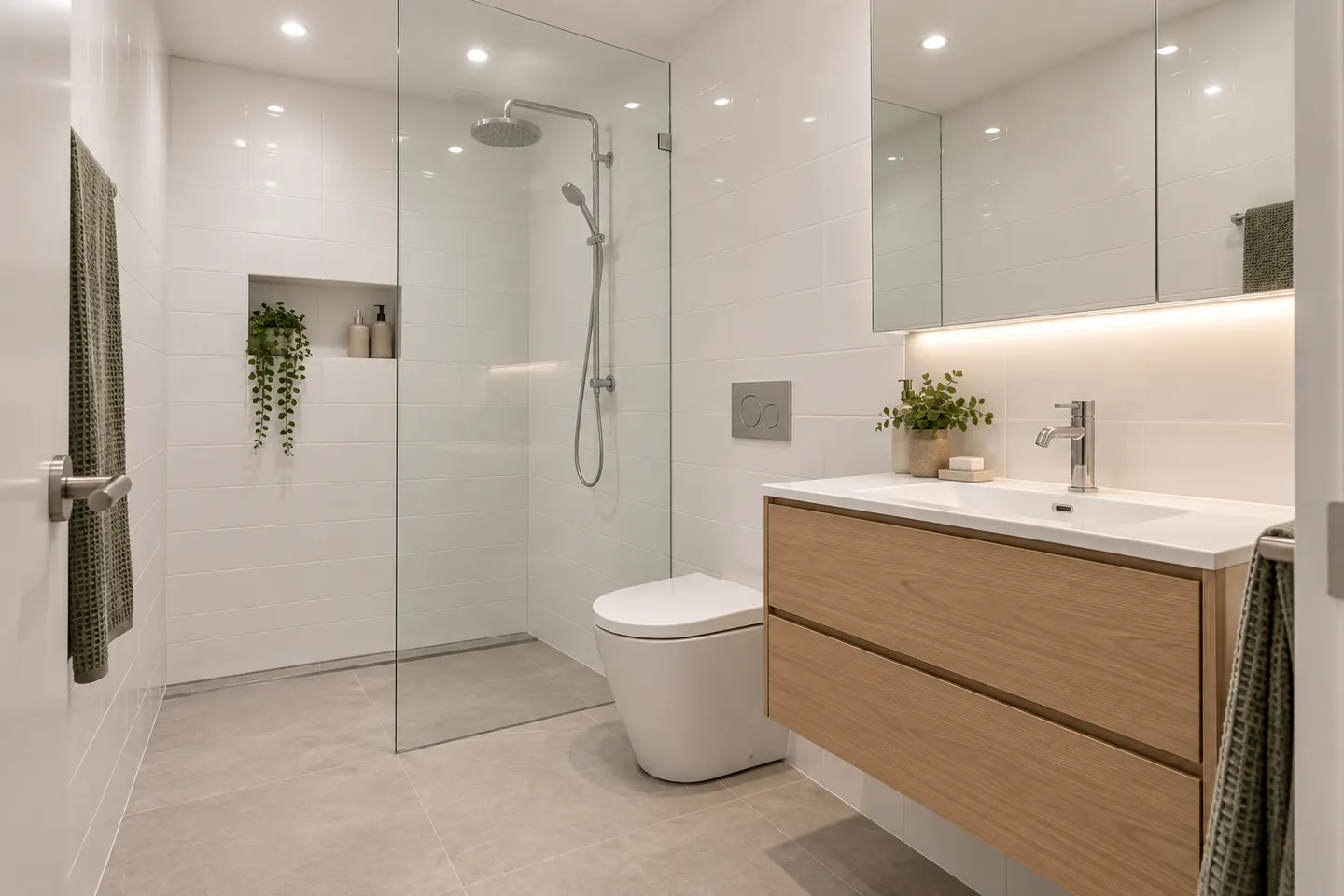
Two kinds of small bathroom
In Hornsby Shire, a small bathroom usually means one of two things.
A unit bathroom near Hornsby or Waitara stations. Older walk-ups from the sixties and seventies have compact bathrooms on concrete floors with a bath under the shower, and newer apartment buildings have bathrooms that are small by design. Both come with strata rules and neighbours on the other side of the wall and ceiling.
A narrow house bathroom in a post-war cottage in Asquith, Hornsby or Thornleigh. Often about 1.8 metres wide, with the bath across the end, the basin beside the door and the toilet in a separate room next door.
They share a problem — too little floor — but the answers are different.
Small unit bathrooms
Strata comes first
Replacing a bathroom's waterproofing in a strata building is generally a major renovation under NSW strata law, which normally means the owners corporation has to pass a special resolution at a general meeting. Some buildings also have their own by-laws on hours, noise, waste removal and the use of lifts and common areas.
What an owners corporation commonly asks for:
- A scope of works describing what is being removed and replaced
- The waterproofing method and who is doing it
- Licence and insurance details for the contractor
- Working hours and a program
- How common property will be protected, including lifts, stairwells and entry doors
Allow time for this. Waiting for the next general meeting can take weeks, and it is better to start the paperwork before selections are finalised than after.
Concrete floors and what sits below
In a unit, the bathroom floor is the ceiling of the unit below. That makes waterproofing the most important stage of the job. The membrane must turn up the walls and seal around every penetration, and the waste connection has to be sound, because a leak does not just damage your bathroom — it damages a neighbour's.
Moving a waste in a unit is rarely practical. It means core-drilling through a concrete slab that belongs to the owners corporation, often with services running through it. Almost every successful unit bathroom keeps the existing waste positions and gets its improvement from the finishes and the fittings instead.
Access
Every tile, bag of adhesive and piece of rubbish goes through the lobby. In a walk-up, it goes up the stairs. Lift protection, trolley runs and limited parking all add labour, and a sensible quote accounts for them rather than hoping for the best.
Small house bathrooms
A narrow cottage bathroom has more flexibility than a unit, particularly where the house sits on a timber floor with a crawlspace underneath.
Combine the toilet and bathroom. Where the toilet is a separate, narrow room next door, removing the dividing wall can turn two cramped spaces into one workable bathroom. The trade-off is losing a separate toilet, which matters in a family home with one bathroom.
Swap the bath for a shower. A bath across the end of a 1.8 metre room takes around a third of the floor. Replacing it with a walk-in shower opens the room right up.
Use the wall depth. Stud walls allow recessed niches, an in-wall cistern and a recessed shaving cabinet, all of which return floor space.
Design moves that work in any small room
- One floor tile throughout, including the shower, so the floor reads as one surface
- Wall-hung vanity with the floor visible underneath
- Large-format tiles where the room is square enough to take them
- A fixed glass panel rather than a framed door that needs swing space
- A cavity sliding door where the door currently hits the toilet or vanity
- Full-height tiling to remove the paint line that makes a ceiling feel lower
- Mirror across the full vanity width to double the room visually
- Lighting at the mirror, not only a single ceiling fitting
Ventilation in a small room
A small bathroom fills with steam in minutes. Unit bathrooms without windows depend entirely on the exhaust, and in some older buildings that exhaust is a shared duct or a weak fan that barely moves air. Where the building allows it, a better fan and a run-on timer make a noticeable difference. Where the duct is common property, the owners corporation may need to be consulted on changes.
In houses, the fan should be ducted outside rather than into the roof space. That is especially important under a tree canopy where the room gets little sun.
What to decide before the measure
- Keep the bath or not
- Whether the toilet is staying in its own room
- How much storage the room genuinely needs
- For units: your strata manager's contact and any renovation by-law your building already has
The cost guide shows current bands for small bathrooms, and tiling explains how tile format affects the price in a compact room.
Licensing
Renovation work is carried out in partnership with Coastal Renovation Group, a licensed NSW builder. Licence and insurance details are provided on request, which is often the first thing a strata committee asks to see.
Call 02 5926 2135 or send the room details through.
Questions people ask before they commit
How much does a small bathroom renovation cost in Hornsby?
As a 2026 guide, a small house bathroom or unit bathroom typically runs $17,000 to $28,000. Unit jobs carry extra costs for strata paperwork, lift protection, restricted working hours and carrying materials, which is why they rarely come in cheaper than a house.
Do I need strata approval to renovate my unit bathroom?
In most NSW strata buildings, yes. Work that replaces the waterproofing is generally treated as a major renovation needing a special resolution of the owners corporation. Your strata manager can confirm what your building requires.
Can I remove the bath from a small bathroom?
Usually, and in a small room it is often the best way to gain space. The exception is a household with young children or someone who relies on a bath, and in some unit markets a bath is still expected by buyers. It is worth thinking about who will use the room next.
Will a walk-in shower make a small bathroom wetter?
Not if the floor fall is right and the screen is sized properly. A fixed panel of at least 900 to 1,000 millimetres keeps most spray inside the shower zone, and a continuous fall to a strip or centre waste handles the rest.